
Mimesis in Classical Greece
A reflection on Ancient Greek aesthetics.

This chapter is a continuation of the introductory chapter The Soul of the Artist. Where we left off, I was spending a summer in Rhodes, Greece while visiting artist Michael Newberry for the summer, while working on a new art foundation.
Experiencing the light in Greece, it seems inevitable that it was where, thousands of years ago, a society developed that was committed to using nature as a model for art.
The Ancient Greeks developed an innovative culture; a society of thoughtful individuals engaged in persuasive argument, the first to discern that the world was a rational order, that the unique faculty of man – that of reason – allowed him to come to know it. The Greeks devised that the path to happiness was a rational and moral life, rather than duty to cultural tradition. And primarily due to the influence of the cult at Delphi, themes of disinterested rule and disinterested justice were broadcast throughout the Greek world. This catalyzed an enormous outpouring of advancement in philosophy, mathematics, science as well as the arts, including painting, sculpture, architecture, music, and theater.
The most important influence on the visual arts was that the gods whom the Greeks worshiped had human form. Homer even gave them human foibles, which Plato would complain about later as sacrilegious.
Greek sculpture starting in about 500 BC began to portray heroic human nudes in a convincingly natural way.
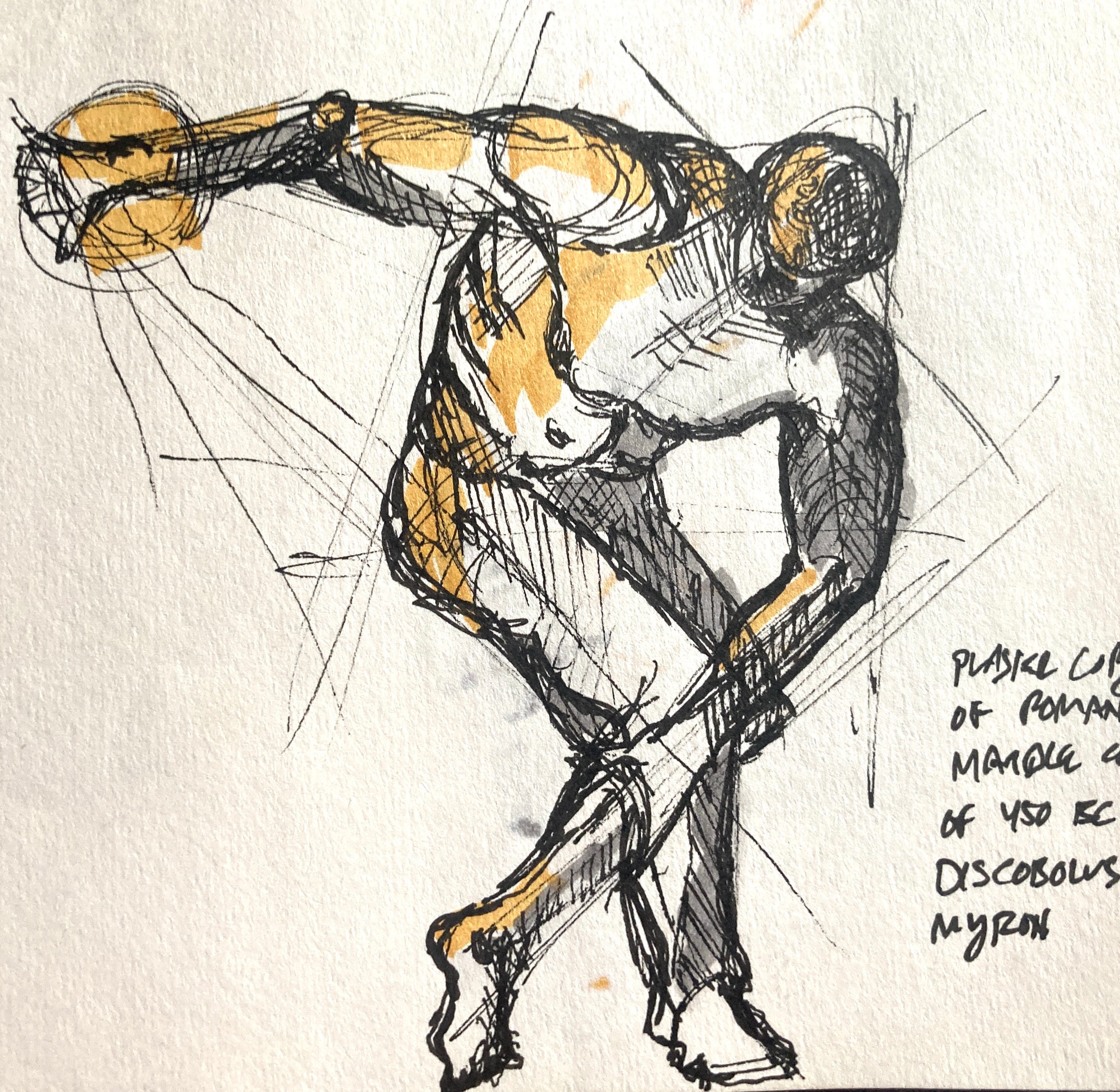
Twenty years after my first visit to Greece, I would go back to draw architectural sites and museum pieces across the mainland, hiking acropolises in 100-degree heat and spending hours sitting in front of sculptures in museums.
A marble that seems to have survived from the hand of the artist was Hermes and the infant Dionysus of Praxiteles (400 BC) on display in Olympia. As the piece had been rubbed with olive oil to preserve the finish, the piece looks new after 2,400 years. It is wonderfully fluid and life-like, obviously made with love down to the last touch.
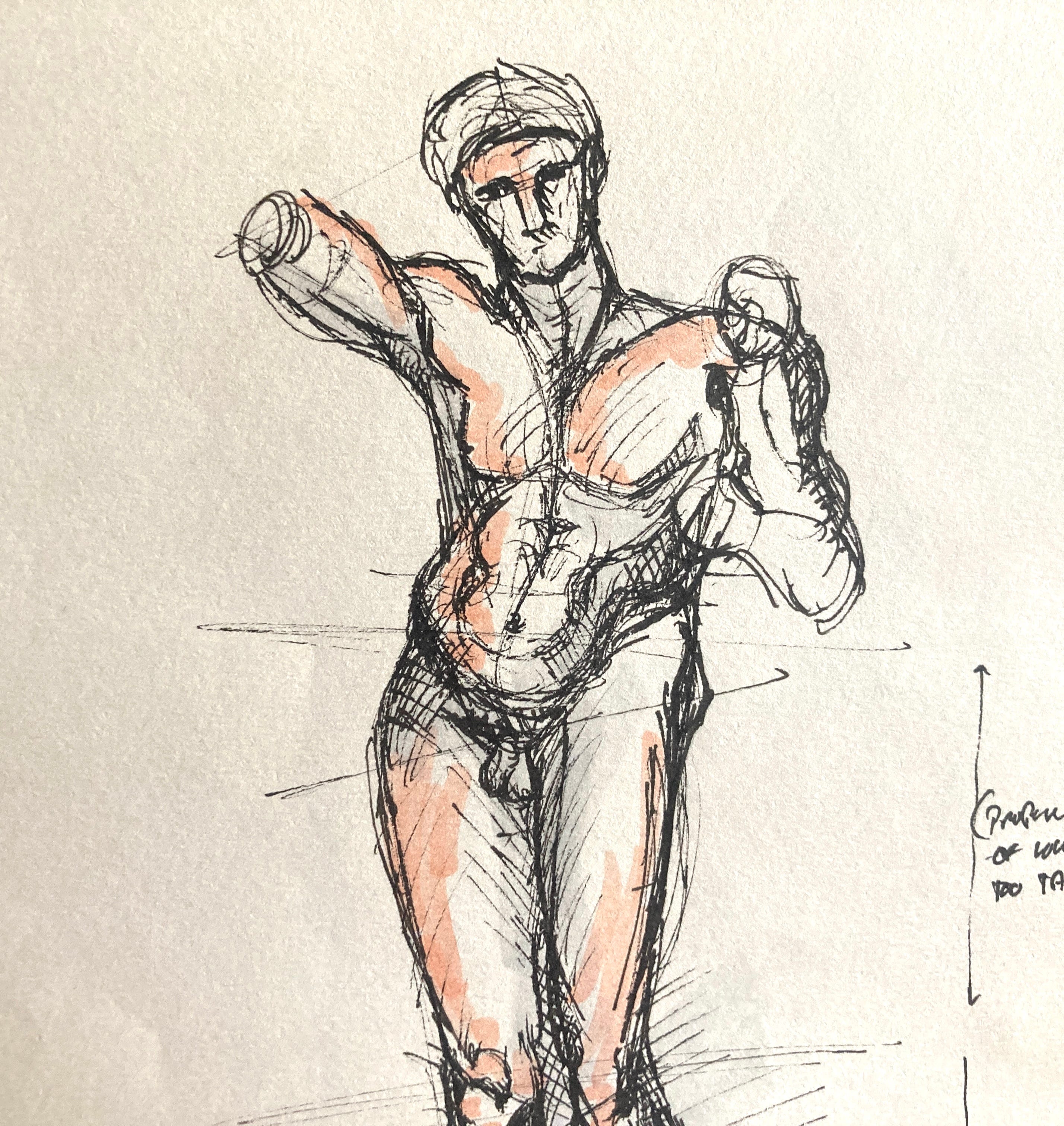
Greece was conquered and plundered by Rome beginning in 100 BC. Many of the sculptures that survived are copies made in marble prior to Rome melting down the originals in bronze. After long hours of sketching, I came to the opinion that while the Roman copies were correctly proportioned, they lack the suppleness of form exhibited in original works such as the Hermes.
Later, Christians felt Greek sculpture to be false idols and destroyed them. Greek monuments were stripped to their foundations. Paintings were almost totally lost. Surviving sculpture is fragmentary; we have no monumental figures despite that those on the scale of Michelangelo’s David were present in Greek temples, often wrought with ivory and gold. Yet enough has survived to offer us a glimpse of the greatness of the civilization.
The work itself communicates how the Greeks felt about visual art. We feel the sense of heroism, idealization of the figure which was the result of synthesizing observations of sometimes several models for the same work, as well as the use of mathematical proportion aided by a detailed understanding of anatomy. It required observation from sense experience as well as applying the rational mind, bent to aesthetic purpose.
But what was that purpose? Sculpture served religious narratives and funerary monuments, but we also know that the Ancient Greeks enjoyed art and contemplated it for its own sake.
Our word “art” derives from Latin (“ars”) and Greek (“techne,”) which, for the Greeks, meant any human activity performed with skill and grace; it is nearly identical to our modern conception of “artistry,” or mastery of a craft. It could be used to describe the art of sculpting as much as shoemaking, so we must look for a different word, and we find that the class of activities that encapsulates painting, sculpture, poetry, music, dance, theater – what we today call the “fine arts” – were discussed collectively as “mimesisai.” The closest transliteration of this is “imitation,” but there has been great debate among scholars as to the appropriate translation of this word, which used to describe representational arts as well as music and dance.
Although Plato had a flair for dramatic philosophical dialogues, he became increasingly hostile to all things dramatic later in life. In Book X of The Republic, we find the first thorough discussion of the imitative arts. Plato attacks them and advocates their abolishment from his ideal state.
He argues that artists can only reproduce appearances rather than the reality of things, and are therefore offer only deceptions, further exacerbated by their total lack of knowledge of the real. A work of art, according to Plato, is inferior to even a mirror, which gives us a more truthful imitation of the real. This argument is strikingly modern; today we ask why it is necessary to paint if we can easily take a photograph.
Plato concludes that art is akin to “play or sport,” (or rather, entertainment) with “no true or healthy aim.” He also seriously criticizes drama for its emotional appeal and representation of temperamental characters, suggesting that this is dangerous to society.
While Plato condemns the arts bitterly, Aristotle comes to their defense, debunking Plato in the Poetics. (However, only a portion of the Poetics survives, and it was more intended for use inside the Lyceum rather than a public dialogue.)
In my following presentation of Aristotle’s arguments, I will utilize my use my own substitutions for “mimesisai” based on my own research.
Aristotle argues that it is natural for us to learn by seeing something demonstrated and acted out for our benefit, allowing us to grasp its meaning. We also delight in illustrations of educational value even when those are of grotesque subjects, because we are learning from them. These examples show that our mind is engaged with what we are seeing.
Aristotle then turns to Plato’s notion that the purpose of art is to parrot real life. Aristotle offers that while, say, a documentary photographer would be concerned with particular things that have happened, an artist would be concerned with universal truths, which are more important.[4] The artist must understand the nature of his subject on a sophisticated level in order to present something that is convincing to us; that aligns to our life experience.
“Mimesisai” was also used by philosophers to discuss the manner in which particulars resembled (were related to) universals; it may have partly meant “being true to the nature of a thing,” rather than simply “parroting the appearance of a thing” (with the derogatory inflection Plato gives it).
Art must also be compelling and deliver an emotional impact, which is the purpose of the creative design, such as the plot of a narrative. Mimesisai apparently described music and dance most acutely, which led scholars to tear their hair out for centuries trying to grasp the meaning of the word. These arts are composed of creative design exclusively, and the emotional impact is intuitive rather than didactic or representational.
In the visual arts, artists in Ancient Greece emulated nature in an expressive manner, not simply parroting it, but capturing it, being inspired by it, and thoughtfully referring back to nature as the measure of success, with an aim to achieve something that looked natural.[5]
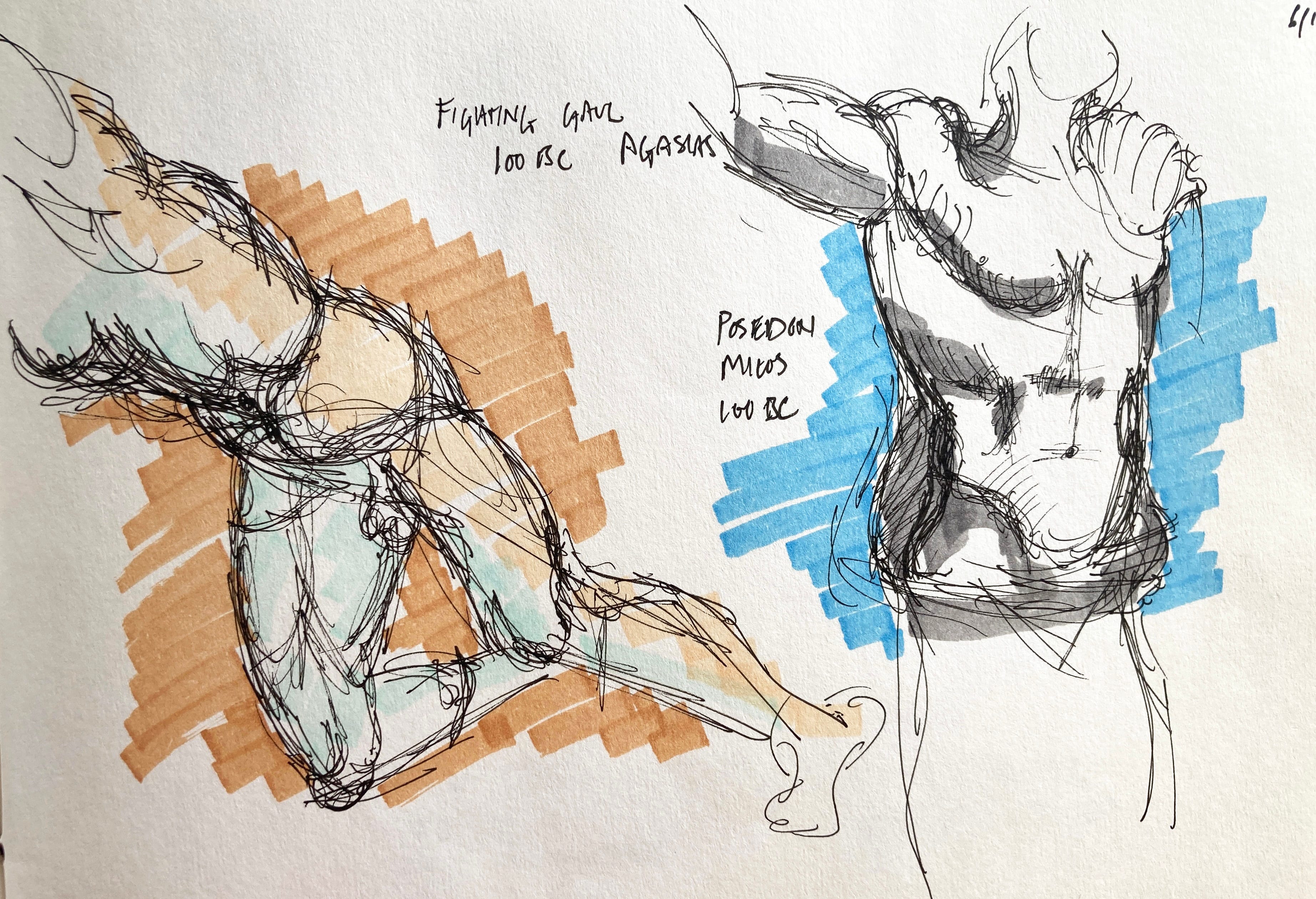
In a museum in Athens, a friend and I stood in front of one of the muscular nudes of Poseidon, wondering out loud who they found to be the model. The musculature rivalled the best body builders today. Yet, sculptors were known to use multiple models to complete one figure. They assembled and synthesized the best parts of each to create a stylized idealization that nevertheless looked convincingly real – it appeared natural despite its fictions. This was aided by rigorous knowledge of anatomy and mathematical guides for proportion (we know the both Praxiteles and Polykleitos developed their own systems).
The sculpted muscles were better defined and more consistently proportioned than real ones, but it was also ancient times; muscles were useful for fighting wars, taming animals, and lifting heavy stuff.
Inspired by the Greeks, Michelangelo brought back figures that were totally ripped, and had a big impact on those who followed in his footsteps (the “Mannerists,” who sculpted in the manner of Michelangelo.) Today, such figures seem out of place unless depicting professional athletes or body builders.
The idealization of the Classical period in Ancient Greece slowly gave way to more visceral reality in the Hellenistic period, in which we see more unique individuals gesturing more truthfully with more unique faces. Perhaps Greek artists perceived that while it was impressive to behold an ideal figure, but was more emotional to be reminded of real people.
The purpose of the work of art came down to “catharsis,” the outpouring of emotion in response to a work. For this, Plato had nothing but suspicion and contempt.
There is a sense in which looking at the art of Ancient Greece is looking through a sheet of glass, two thousand years compressed to merely an inch. They were astonishingly modern. It is difficult to transport oneself back into ancient times and remember that they were the only civilization making art of this kind; it must have been electrifying to see such natural vitality in art.
For Greeks, and especially for Aristotle, sense perceptions are a source of delight and enjoyed for their own sake. Rationality is also instinctually delightful, and beauty is beholding what is rational and moral; acts of virtue afford pleasure for their own sake.
We can’t help but imagine that an artist in Ancient Greece felt the impulse to create something from the depths of their own soul, and like artists in any era, they must have gravitated to ideas they were fascinated with. But an artist of that time, and one of almost any era up until the 19th century, were still embedded in a society that believed artists were craftsman, were paid to do a job – a commission – that likely had very well-defined parameters, and success was measured by how well one followed through on the goal.
In a similar vein, we can’t help but imagine collectors finding elegantly done works and gravitating to artists they loved in order to surround themselves with a ‘collection.’ But that collection was likely more closely tied to architectural ornament and religious ceremony; this would also be true until very recent in history.
Modern Mythic Narratives
The mythical narratives of Classical Greece infected Newberry while living and painting there, leading him to make paintings inspired by Venus (Aphrodite), as well as Artemis and Icarus.
While living in Greece, Newberry had been inspired to do a series of works inspired by Greek myths. One of the paintings in process was an interpretation of the
birth of Venus, which had been depicted by many artists including Botticelli in 1480, who placed her fully grown, standing nude on a scallop shell. Newberry placed Venus on the beach at dawn, with rocks at her feet resembling a shell, portraying a life-like scene that might have inspired the first artist who depicted a seashell. The landscape behind her was the coast of Turkey, which along with the craggy outcropping of rocks was captured in pastel studies on location.
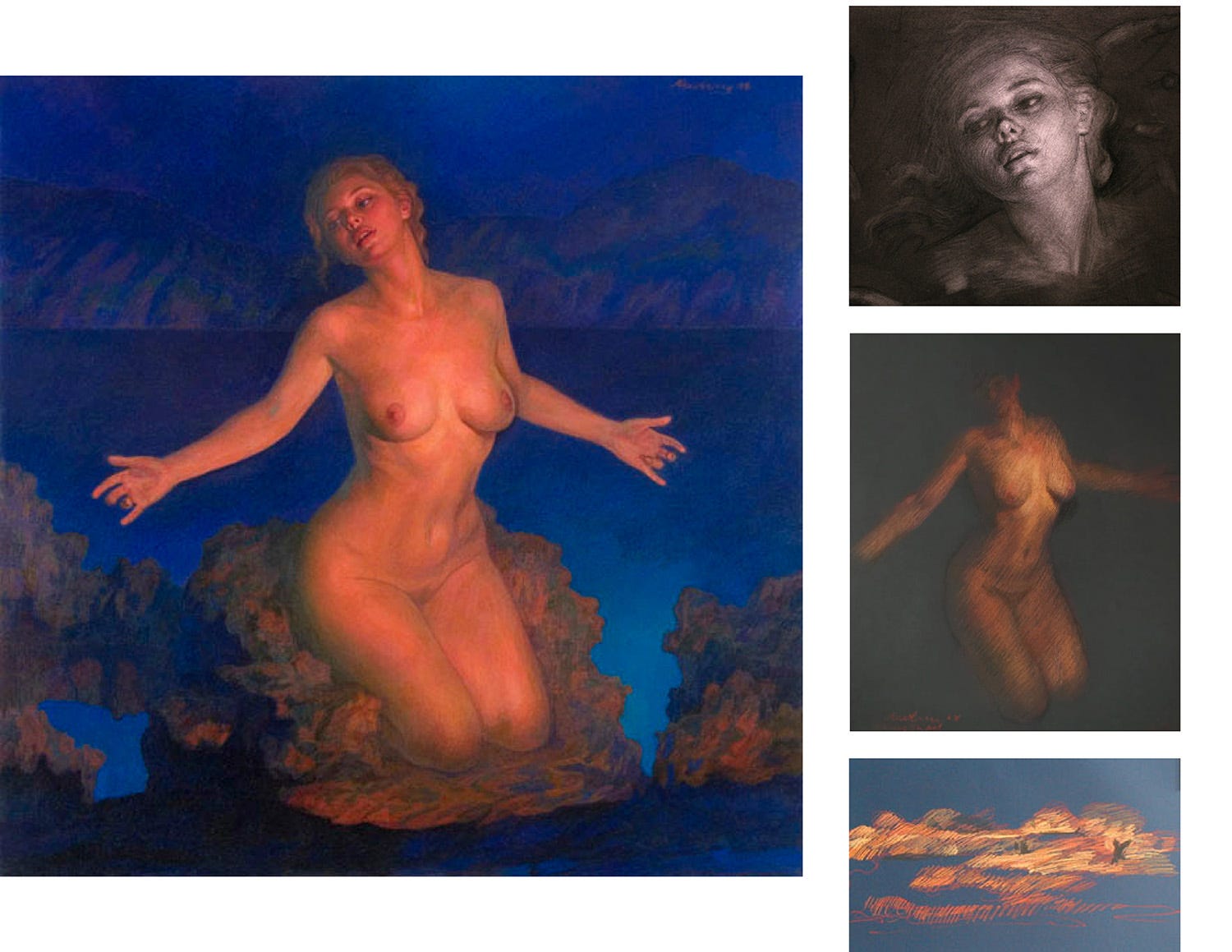
During my stay of three months, the foreground and background slowly came to life, overpainted many times. On a different schedule, Newberry painted in the figure directly from life with a stunningly beautiful friend—a tall British woman and founder of an advertising firm— serving as the model. The arrangement was kept secret at the time to avoid gossip.
When finished a year or two later, the Venus radiated a golden glow; her arms are held out to either side and her head is half-turned as if to accept the caress of the sunlight on her body for the first time.
Some mornings before starting my work on the foundation for the day, I would rise early to walk to the beach and swim in the sea at dawn. The sun, beating down on my body, would give the wet, tanned skin a golden glow, the same as that caressing Venus. I looked like a Greek god.
In Greek mythology, Icarus was the son of Daedalus, a celebrated master craftsman. When both were imprisoned in a labyrinth, Daedalus fabricates wings constructed from bird’s feathers, and the two of them fly away. Icarus was warned not to fly too high, for the sun would melt the wax used to construct the wings. Despite the warnings, he does so and falls to his death.
The myth was a warning against ambition; in the Homeric world a man could not rise too high without fear of retribution by the gods. Yet Newberry had an “absolute inner belief that magnificent experiences are the stuff of living.” In his painting, Icarus lands safely, reinterpreting the myth. He does so with arms outstretched, hovering on air, the wings implied as a levitating force, just before stepping down on a beach that was painted plein air at a nearby location, at Kallithea.
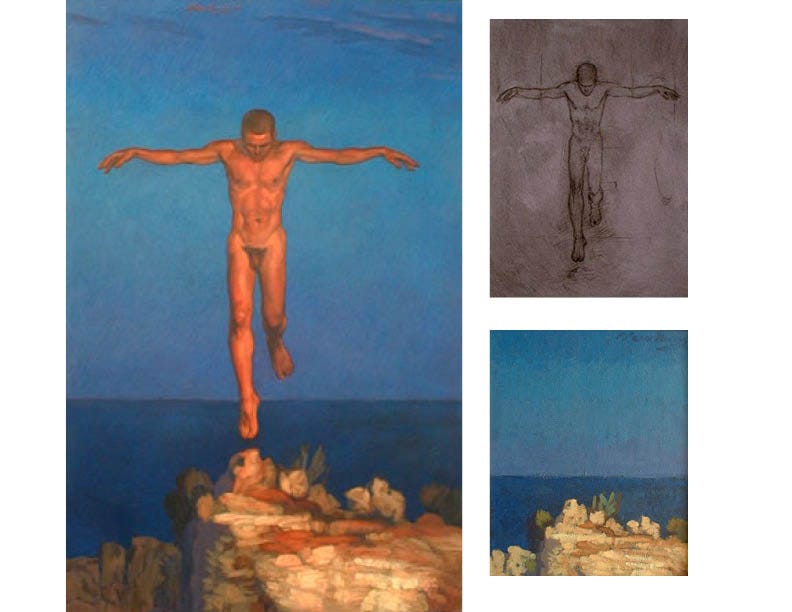
In the initial concept sketch, Newberry decided to omit the wings and immediately discovered a shocking possibility with the painting. Icarus’s arms give him a surprisingly powerful symbolism of the crucifixion, juxtaposing both the Greco-Roman myth of Icarus and the Judeo-Christian myth of Jesus at the same time, but offering a humanistic vision in which great aspirations are achievable with grace and beauty.
Icarus, despite the Greek placement, is also a modern figure; he is not bulky or godlike, but lithe and modern. The complexion of the skin is incredibly natural, and the body, in warm oranges, hovers over the blue seascape. Sitting on the floor looking up at this painting for an hour, the figure seemed to float about six inches off the surface, while the sea receded deeply in space.
The power of art to convey emotion as well as intellectual themes is what has given representational art so much value to religion and political propagandists. Yet, an artist advancing their individual voice from a deep place in their own soul to say something important about the nature of existence, outside of the context of social, religious, or political systems and without any guaranteed payment for the work, is a stunningly new possibility for artists in the modern world that has never been seen before.
I hope you enjoyed this segment from the forthcoming book: Everything is Beautiful: The revival of observation, realism, and beauty in fine art by Brett Holverstott. I encourage you to join the conversation!
A wonderful deep dive filled with informative details, Brett. Looking forward to your new book. Cheers!